The AI Paradox
In today's world, using AI has become a matter of necessity, love it or hate it, you're kind of forced to use it.
People who refuse to get on the AI trend simply fall behind their peers in terms of productivity and efficiency. Instead of spending time learning brand new skills, people are growing more and more reliant on AI to do their thinking and talking, I've personally seen many instances where someone had to ask CHATGPT to respond to text messages in a certain tone because they had no idea how to reply to a simple message!
This, of course, is disastrous, if the future of communication between people is just AI bots that "understand" the user's personality, texting back and forth to determine if two people could be compatible as friends or colleagues then that future is definitely a more lonely, gloomy one.
PS: Personally, I've always found it interesting chatting with people who have many differences from me, ideological, moral or even religious differences always present a brand new view-point that you may have not been aware of, cutting that out of your life opens ways into endless echo chambers, and even worse: ideological extremism.
We've all heard the claims in this MIT study, that peoples brain activity significantly scaled down when receiving external support from LLM models like CHATGPT. The headlines about this, however, are deceptive and ride on peoples fear and misunderstanding of AI, as this is a pretty normal response for a human brain when receiving any kind of external support, a well documented phenomenon termed cognitive offloading.
The real problem here is that the human brain, with constant abuse of just using AI, is beginning to atrophy, at the end of the day the brain is a muscle that needs constant exercise, deep thinking and diving into sessions of pondering to be able to generate brand new ideas, that's what strengthens your brain, while just offloading every single thought and question you have into a box that spits out the answers to your every question in an instant severely cripples that.
But wait, isn't that just what Google does? it's been around for decades and yet we don't see the same outrage nowadays for that as we do for AI, so why is that?
Actually, as seen in this wildly infamous article published in 2013, google DID get a lot of flak for it's role in 'making people stupider', where the author argues - through this clickbait title - that the internet as a whole has made our brains think faster but albeit a lot shallower, an effect we can see trending again with short-form social media content and AI!
So this has happened before, and the world has continued to live-on, and some would even argue that after google launched it has improved life quality for the individual person, and assisted in scientific breakthroughs and development that traditionally took humanity hundreds of years to reach.
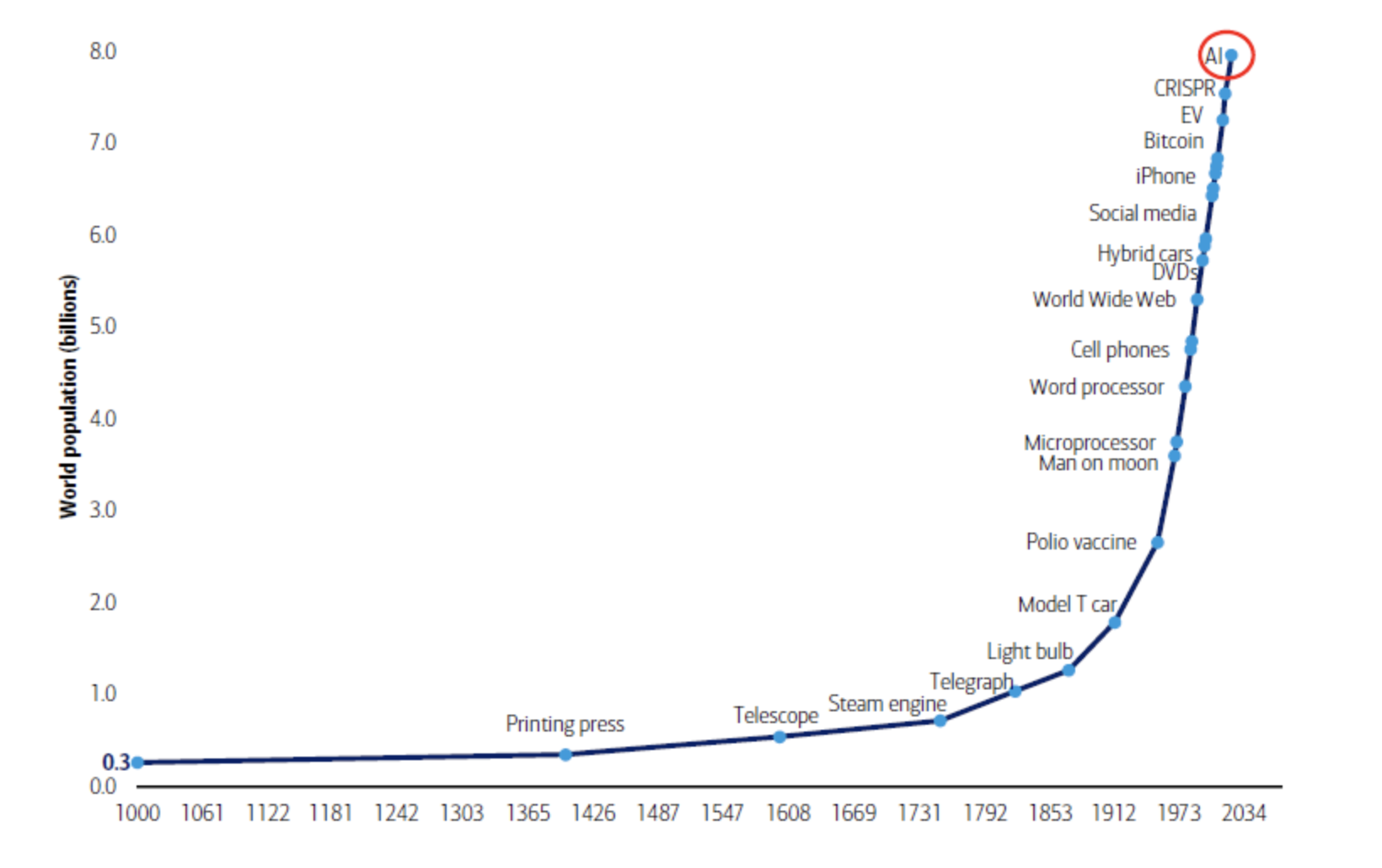
Source: BofA Global Investment Strategy, Global Financial Data, How Tech Has Advanced Over The Years,
So Where's the Harm?
AI is a double-edged sword, yes it frees up your time, gives you access to tools and skill sets that you traditionally would need to invest many hours of time and effort into learning before being able to exploit. The harm comes, as it always does, in abusing AI, over-relying on AI, now that you have more time you SHOULD be using it for being creative, thinking, writing, doing what a machine could never statistically generate, breathing soul into creations that aren't algorithmically generated, design workflows unseen before with the confidence that you can create an MVP without needing to take on the biggest amount of risk.
While yes, you do gain an advantage/keep up with you peers when using AI, especially in today's landscape of ever evolving tech, but understanding the tech, being able to explain it when pressured, knowing how to code, write, text and function while understanding it all at the least in a basic level has to this day remained to be a corner stone in my eyes for squeezing out that 'competitive edge' over everyone.
I use AI, I do admit that I let it do for me much more than I am comfortable, but I never let it be unsupervised, I review most lines of code and understand how they function, I manually edit code as well to get to the exact target I have pictured, I double check every single generated word/action that my AI agents perform, this has allowed me to be more creative while delivering the exact vision of brand new projects I am certain will hold up against scrutiny.
The Paradox
I've seen many people now integrate AI into their daily routines to push donkey work out and automate most of everything, but employers do take notice of this, and this usually means that harder, more complex tasks could be presented to employees that do push them into having to think outside the box. The box not just being metaphorical at this point, but also the AI box.
You see, AI is not omniscient, you will start facing problems that AI models have simply not been trained to handle yet, and when you come up with these 'ground-breaking' solutions, you'll find that AI may have helped you implement but could never have come up with it on it's own.
You go back to thinking and rubbing your head for hours trying to break-through, only for the newest LLM to come out and make coming up with ideas like this seem like a piece of cake. This is an arms-race, because if AI can automate this, and automate that, and automate most of everything then wouldn't it approach a singularity at which AI could just do everything for someone and provide the needed service?
In my opinion, No, due to one big factor of many: Capitalism.
Imagine a world where AI implements the perfect solution for every company, and every company starts operating at the same level of 'perfection', that would mean that choosing which business to work with wouldn't matter, and that is simply not something that works with good ol' capitalism. you'll start seeing innovators once again trying to one-up each other. Even if AI elevated to the point of AGI, it still at the end of the day just an algorithm, a black-box guessing the most probable next word to say, the next most likely line of code.
AI can never truly be creative, and while it is true that for some their jobs would be invalidated, as happened in the first and second technological revolutions, new jobs rise in their place, jobs that AI could simply never take because they are so uniqely human.
You WILL need to go back to scratching your head, thinking and innovating into new solutions that AI could never guess.
Conclusion
While we barrel and hurdle our way into - and through - a brand new technological revolution, remember that life, and humanity in general, has faced bigger changes in the past, and brand-new challenges rose and with it did a sea of innovators, thinkers and designers.
For today, learn how to use AI the right way, don't just blindly abuse it and hope for the best, building a mountain of knowledge-debt that will inevitably come crashing down when placed under any sort of scrutiny, and prepare for AI to be the brand-new basline of quality by arming yourself with the skills and know-how to come out at the top again.